Monday, May 13, 2013

New WW2 Game and Pulse of Battle Update

Sorry that it has been a while (well, actually...a long while) since I last posted.  Real life with multiple business trips and home projects had severely cut into my blogging time!

In reverse order of the post's title - an update on Pulse of Battle:   The text is complete, and edited thoroughly.   Final, final work is being done on the army list text, and then it will be time to take photos and do the final layout of the rules.  I'd really like to get this off my plate no later than sometime in June, but we'll see how the schedule works out....

I'm extremely happy with PoB and how it plays.  I think its a unique approach to ancient combat, yet fully in line with the Piquet/Field of Battle emphasis on the fog of war and command challenges.  

With that creative project wrapped up, I've turned to the WW2 squad level (every unit = an infantry squad, a vehicle = 1 to 3 vehicles, etc) game, tentatively (very) titled "Follow Me".   It's aimed at allowing multiple companies up to a battalion or more on the table per side.  

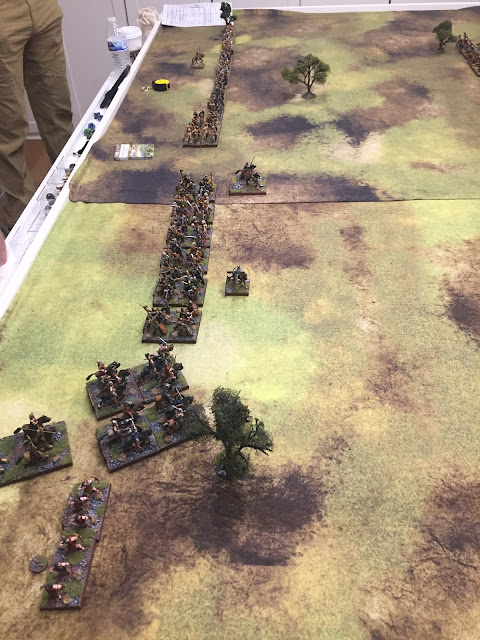
We played 2 games last Saturday night.  The first had two recon type forces fighting over control of a strategic road intersection.  The US had two companies of infantry (18 units) plus 4 MG sections, plus a platoon of M8's and a Stuart.  The Germans had an armored recon platoon (armored car and a halftrack) plus an infantry company with a couple of HMGs.   Both sides had offboard mortar and artillery assets (available via an asset deck of cards).

The second game was an extremely armor heavy game with 3 Sherman platoons (9 units), an M10 TD platoon (2 units) and the M8 armored cars, plus a couple of platoons of infantry (6 units) vs. a German force of a Stug Platoon (3 units), a PzkwIV platoon (3 units), a Panther platoon (2 units), and 2 platoons (6 units) of PanzerGrenadiers in halftracks.

The US won the first game handily, and the Germans did the same in game 2.  The first game (with the rules being entirely new to the players) lasted around 2 hours, and the 2nd game lasted around 1 3/4 hours. 

Overall, I was thrilled with how the games played and felt.  I always feel more than a bit nervous when I trot out a new game for the first time.  Its hard to guess how things will go...

Some photos from the games:


Monday, April 1, 2013

Lame, Lame, Lame

Well, it is April Fool's day, and with it the inevitable flood of lame (LAME) blog updates and TMP posts.  

You know the type:

a)   I've decided to leave wargaming as a hobby and take up (insert lame hobby of your choice).
b)  I've decided to only do 1mm armies, or armies made of rice grains, etc.
c)  There's a new manufacturer of X line of figures - in 31.8mm!    I've been looking for all of these for years!!!
d)  There's a new software program that reads a gamer's mind and requires no manual input to totally automate the game and rules process!

Maybe I'm just old and grumpy (I turned 50 in June)......but I find these repetitive, lame, April Fool's day posts to just be.....well.....lame.   They're not funny, not engaging, nor interesting.    At best, they're......lame.

Happy April Fool's day.

Saturday, February 16, 2013

Musket, Rifle, Skirmishers.....Ranges

I'm reading a fascinating book by Earl Hess - "The Rifle Musket in Civil War Combat, Reality and Myth".   Hess follows very much in line with Paddy Griffith's earlier work, and convincingly lays out evidence that the rifle musket did very little to change battleline combat ranges.  A combination of visibility, unit control, tactical decisions, terrain, and weapon ballistic characteristics, made the rifle musket battleline engagement ranges somewhat longer, but still appreciably short of what the weapon's capabilities were.   I don't have the exact number, but he suggests that the average battleline engatement range was around 90 yards, vs. 60 to 70 in the Napoleonic era.

BUT - the big difference was that skirmishers and snipers now had a much more capable weapon, and used it with effectiveness.   The skirmish ranges would be 200+ yards, with skirmishers deployed from 100/200 yards in front of the battleline to as much as 500 to 800 yards!  

Hess points out that the Federal armies had a distinct skirmish advantage when compared to the Confederates in the Western theatre.  In particular, he spends considerable time discussing the Atlanta campaign, when skirmishers really came into their own.   Part of the Federal advantage was leadership and an emphasis on skirmishers, while part of the Federal advantage was that they had the supply system in place to provide plenty of ammunition for the skirmshers to fire off!  Confederate units labored under ammo limitations, and fired distinctly lower numbers of rounds.

I started thinking about representing skirmishers in Field of Battle.  I truly think wargame rules get skirmishers wrong.  In my opinion, they're best represented as an abstracted benefit.  Its very difficult to model one of their primary functions - intelligence, being the "eyes and ears" of a unit.

I think the best way is to look at unit ranges over the horse and musket period.   From "bad" skirmishing or non-skirmishing Napoleonic systems and earlier (SYW, WSS), I can broadly say that there aren't significant skirmishers.   They'd use the battleline vs. battleline model, with roughly a 100 yard range. 

As you get the "good" Napoleonic skirmish units (French, British, later Continental armies), that range doubles, as a skirmish screen proceeds the battleline.  So, let's say the range is 200 yards.

For the ACW, those numbers just go up, to a net of 400 yard range.

The longer ranges are abstracted in game terms by the long range of the units.   I'd propose that an interesting tweak to Field of Battle would be to disallow long ranges for units that were "out skirmished.   I tossed the graphic (below) together to illustrate my thinking.

I need to stop messing with this and get back to editing Pulse of Battle!

Tuesday, February 12, 2013

Pulse of Battle Update

I haven't been posting many updates lately, as I've been focusing on using my free time to work on writing on Pulse of Battle.   I chuckle when I see the "One Page Rules" discussions on The Miniatures Page.   Hmmm.   One page rules.   What they really mean is 1 page reference sheet.   It's quite impossible to have a 1 page set of rules.  There are sooooooo many situations and questions that players have when playing a game.  I'm not saying that my rules are exhaustive, but they are aimed at being precise, concise, and easy to use/comprehend.    You can't do explanations in one page for everything.....

We played a final set of test games last Saturday with Pulse of Battle.  Two games, 2nd Punic War.   The Carthaginians had the advantage of a large leadership advantage, and somewhat better troop quality.   They won both games, which wasn't too much of a surprise.

I'm very happy with PoB now.  Only a couple of minor fixes popped up in the game, and the games played really well and smoothly.

PoB is now in the edit phase.  It's in the hands of 4 thorough and capable editors, who are providing tons of edit suggestions to me.   I think this set of rules will be by far the best edited, "cleanest" set that I've done. 

That being said, I'm sure I'll see errors and typos when the first printed copy arrives!

A couple of photos from the games:


Sunday, January 20, 2013

Ravens - 49ers in SB

Hmmm.   Battle of the Harbaughs in the Super Bowl - what a great family accomplishment!

Being a lifelong Denver Bronco fan, this past week was tough after losing to the Ravens last Saturday.   I do have to say that I feel better after watching the Ravens throttle the Patriots, The Hoodie, and Tommy Boy.   At least the Broncos played the Ravens tough, and it took OT to win in Denver.   Losing by 15 at home in the championship game?   

I admit to enjoying this a great deal.   Maybe that has to do with McDaniels being the Patriots offensive coordinator again - after the debacle where he was the Broncos head coach and he ran the team into the ground.    After the Raiders, the team I can stomach the least is the Patriots.   Far too much smugness and arrogance for a team that hasn't won the SB in quite some time....and not this year either!

I only wish that some other team would give McDaniels a chance to ruin their franchise by giving him their head coaching duties.  Then I could add another team to root against on NFL Sundays!

Saturday, January 19, 2013

Town Sections

I've been quiet on the blog front for a while.  I've been busily painting 25mm Carthaginians and working away on Pulse of Battle, the new ancient rule set.  

I also decided to finally create new town sections for all of my scratch built buildings.   The sections are 6" x 6", and are treated as an area/module in my rules of choice - Field of Battle 2nd Edition.

Some photos:


Thursday, December 20, 2012

Proportional Gettysburg - Battlefield and Scale

I'll do these posts as I work through the scenario, proportioned for a smaller miniature army that is functionally possible to use in a reasonable length game.

A quick look at a map shows that the length of the Gettysburg field, from roughly the end of Little Round Top to the other end at Cemetery Hill is around 7000 yards.  I haven't decided if the first day's battle will be included or not.  For this exercise, I'll just use the 7000 yard figure.

My table is 108" ( 9 foot).  So - 7000 yards/ 108" = 64.8 yards per inch.  I'm comfortable enough with my historicity to round that up to 1" = 65 yards.   My preferred set of rules is Field of Battle, 2nd Edition.  FoB's nominal ground scale is 1" = 25 yards.    The actual to game ground scale ration is 65/25, or 2.6.    I'm happy to say that the real to game ground scale is somewhere around 2.5 to 3 to 1.

So, this begins to tell us what kind of game proportioning (real units to game units) we'll see.   If we assume the same 2.5 to 3 to 1 scaling, we can start to see where we are.

Assume that the game unit is the game representation of the nucleus of the multiple units it represents.  The multiple real units would be deployed "somewhere" around that game unit nucleus, with 2.5 to 3 times the frontage.   This means we'd also have more depth than the nucleus game unit.  So, if we make another assumption (never assume, or it will make an....), and say that we have something like a box of 2.5 to 3 real units wide by 2.5 to 3 real units deep roughly centered around our game nucleus unit, that means that the game unit represents something like 6.25 to 9 real units.   I can live with rounding that and saying 1 game unit = 6 to 9 real units.

At the least detailed OOB level, the Army of the Potomac had around 93,000 men.  The Army of Northern Virginia had around 73,000 men.   Let's assume, for the sake of conversation, that the infantry present for battle (leaving out cavalry and artillery) represents around 60% of those numbers.  That leaves us with around 55,000 for the AoP and 45,000 for the ANV.   If we take that further, and assume that each infantry regiment is 500 men, then the AoP has 110 regiments and the ANV has 90 regiments.    Are these numbers correct?   I don't know.  I have plenty of resources to acurrately figure this out, but quite honestly, this is for a game, not a dissertation and I just don't want to go to that level of research!

So, if you're still following along, we were looking at 1 game unit equaling 6 to 9 real units.   That means that the AoP would be 110/6 to 110/9 infantry units, or somewhere between 12 and 18 infantry (game) units.   Similarly, the ANV would be somewhere between 10 to 15 game units.

My ACW collection (25mm) presently has 15 Federal infantry regiments in it.  Zowie!   15 units is right in the middle of the 12 to 18 unit range we're looking at above.   If I follow proportions, the ANV would then have 12 infantry units or so for the game.

What does each game unit represent?   Surely at the extremes, a very large brigade to a division of real troops.   Does that change the game?   Not in the least.

Next will be a scaling of support units (cavalry and artillery) to get that correct.

This is actually quite a bit of fun!   Now its back to the painting table to work on Libyan spear units for my Carthaginian army (Pulse of Battle).